
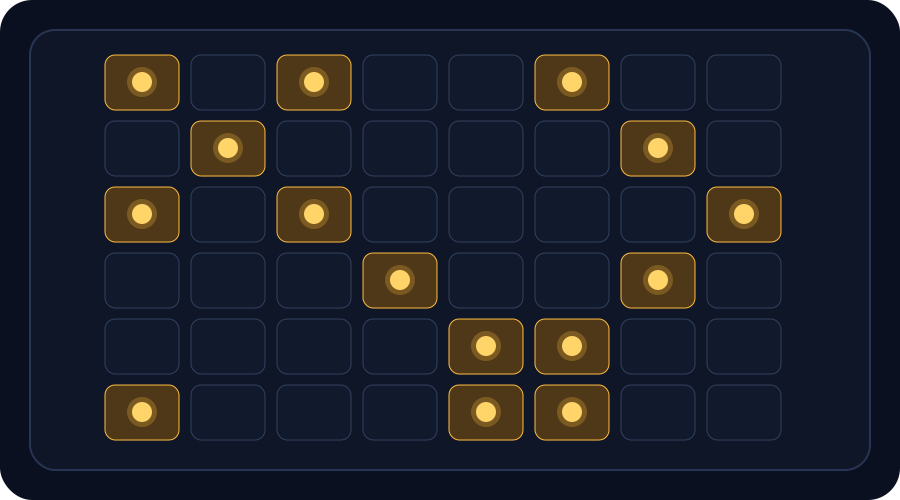
The objective
Lights Out is an algebraic toggle puzzle disguised as a simple grid. Every press changes several cells, so the important question is which combination of presses can clear the board.
Rules and controls
- Step 1. Tap a light to toggle it plus its up, down, left and right neighbors.
- Step 2. Your goal is to switch every light off.
- Step 3. Difficulty reflects the board’s minimum solution length, not only board size.
- Step 4. Solution highlights one shortest set of presses. The highlighted cells may be pressed in any order and the guide recalculates after every move.
Easy, Medium and Hard
3–5 minimum presses
9–12 minimum presses
15–20 minimum presses
Difficulty on Snapoki is designed to change the reasoning pressure, not simply enlarge the board. The exact pressure depends on the engine: route dependencies, fewer clues, delayed consequences, deceptive branches or higher minimum logical actions.
Strategy that helps
- Think in patterns rather than repeatedly pressing the brightest-looking area.
- A cell only needs to be pressed zero or one time in an optimal solution because pressing it twice cancels itself.
- Use Hint as a directional clue, then continue reasoning from the changed board.
Common mistakes
- Random clicking until the board looks better.
- Repeating a press that simply cancels an earlier move.
- Assuming Hard means a bigger board; Snapoki calibrates it by true minimum presses.
Hints, practice and ranked play
Hint gives a limited concrete next action and keeps the attempt eligible for ranking with a points penalty. The full Solution or Guide is a study tool, so using it makes that attempt practice-only. Starting a New Puzzle returns you to a fresh ranked board when signed in.
Daily Challenge
The Daily Challenge gives every player the same Lights Out board for a given UTC date and difficulty. Complete Easy, Medium and Hard to finish that game’s daily set. A Daily difficulty awards its ranked reward only once per account for that day.
Play Lights Out now
Start on Easy to learn the interaction, then move up when the board stops forcing your decisions.